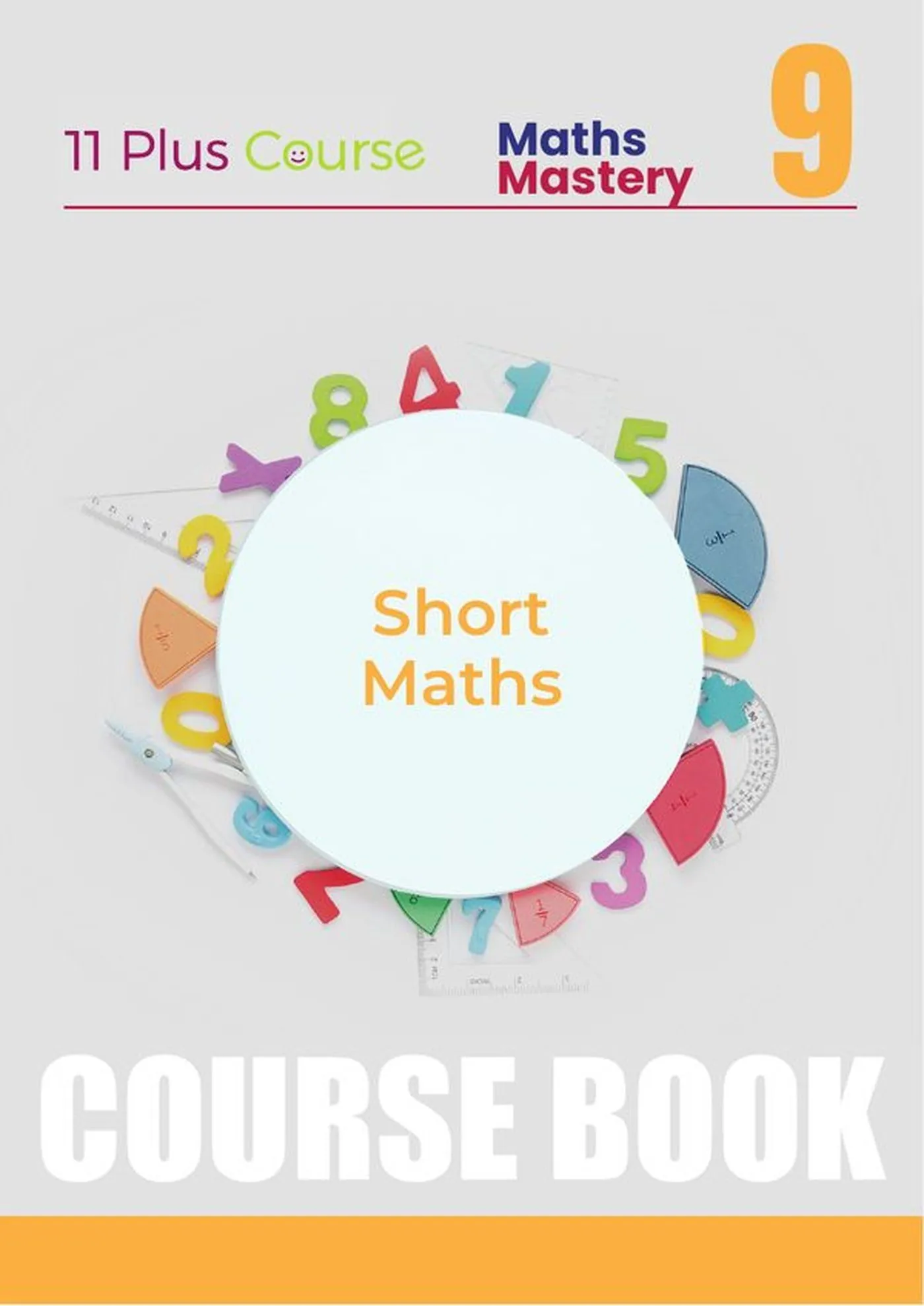
 Click to enlarge
Short Maths
One-mark questions under the clock, where exams are won or lost on care.
- 20 tests in ten levels of one-mark questions
- 30 questions per test, every topic deliberately mixed
- Mastered means 27 out of 30 twice in a row
- Every answer with its method fully worked
Want the whole series? The full Maths series is £247, under £21 a book.
How this book is used in our course
Two tests a week under the clock. Mark, correct, and re-sit each test the next day at exam speed. Mastered means 27 out of 30 twice in a row.
Where it sits in the series
- Previous book in the series: Book 8, Mental Maths Foundations
- Next book in the series: Book 10, Long Maths
What's inside Maths Mastery 9
Four real pages from the book, so you can see exactly what your child will work from. All 9 sample pages are in the viewer.
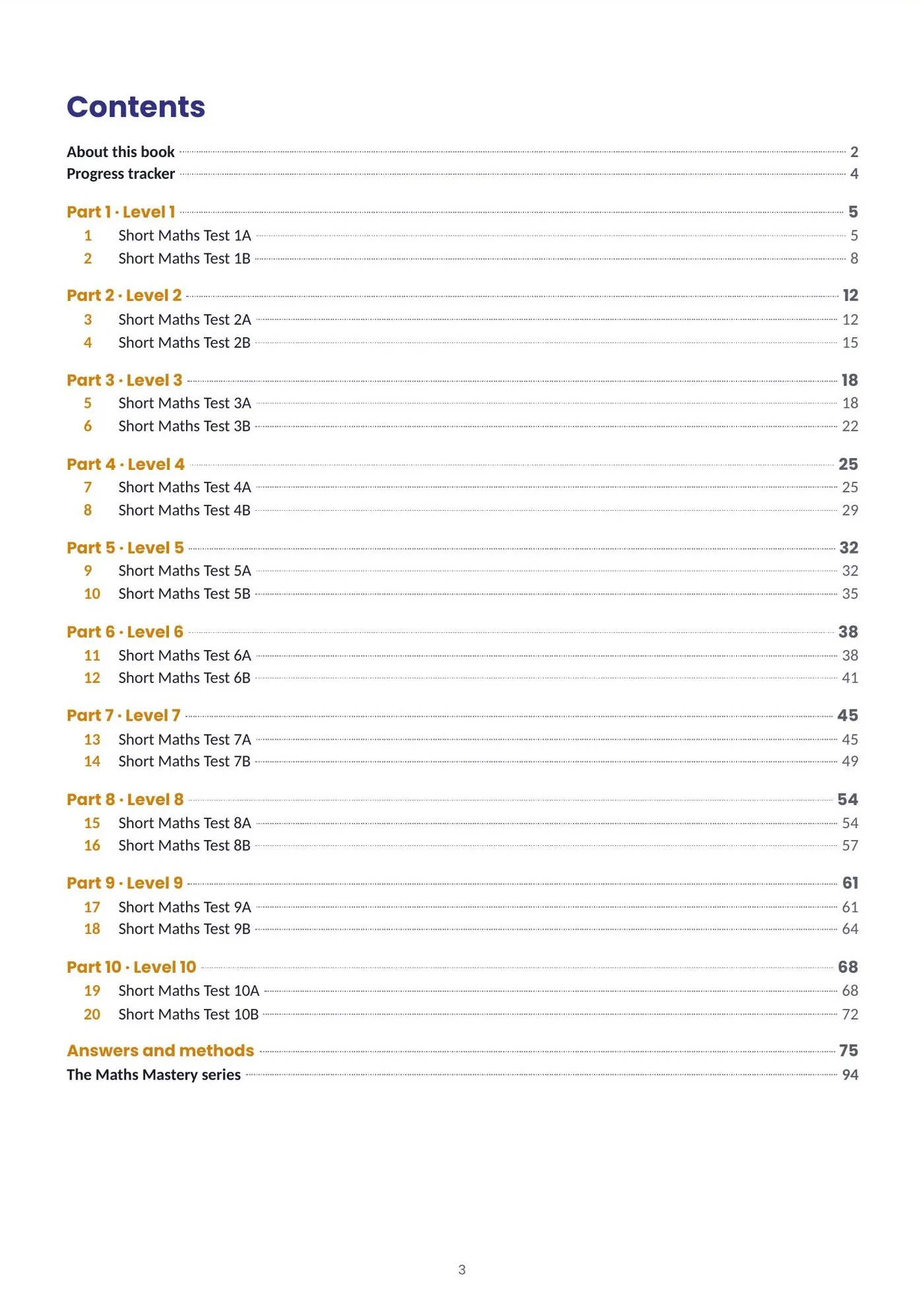
Twenty tests in ten levels: one-mark questions, thirty at a time, under the clock.
Two Short Maths tests at every level from 1 to 10, each 30 questions in a suggested 30 minutes. This is the format of the first half of most 11+ maths papers: short, varied, no marks for method, one minute a question. The levels climb from Year 5 Term 2 fluency to the speed and care the exam demands, and a child only moves up when the level below is mastered.
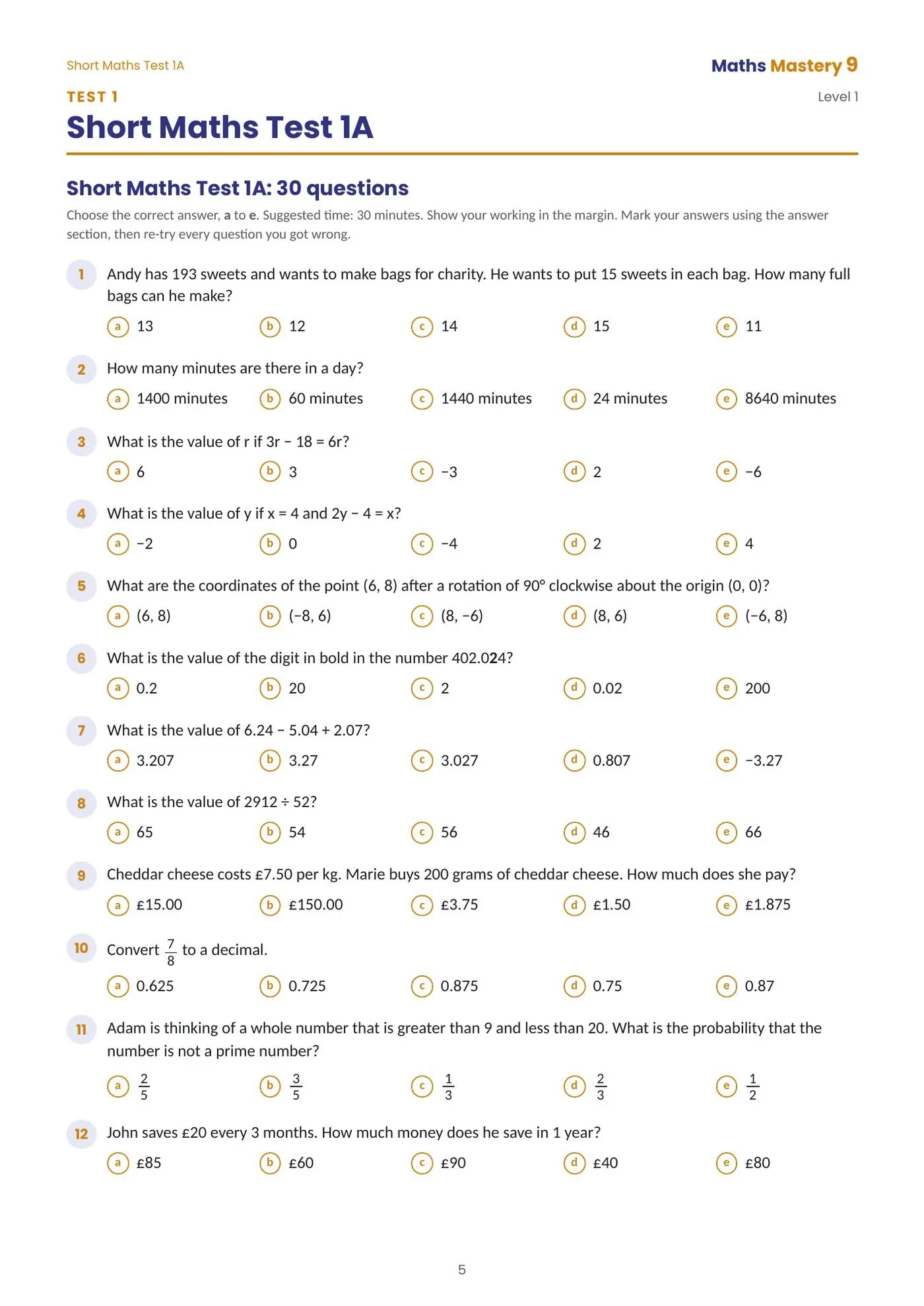
Every topic in every test, deliberately mixed, so nothing can be predicted.
The first twelve questions of Test 1A move from a division with a remainder to minutes in a day, an equation, a rotation of (6, 8) about the origin, place value in 402.024, a decimal chain, £7.50 a kilo for 200 g, 7/8 as a decimal, and a prime-number probability. That is the whole Year 4 and 5 syllabus in one page, which is exactly what the exam does, and exactly what a topic-by-topic book never rehearses.
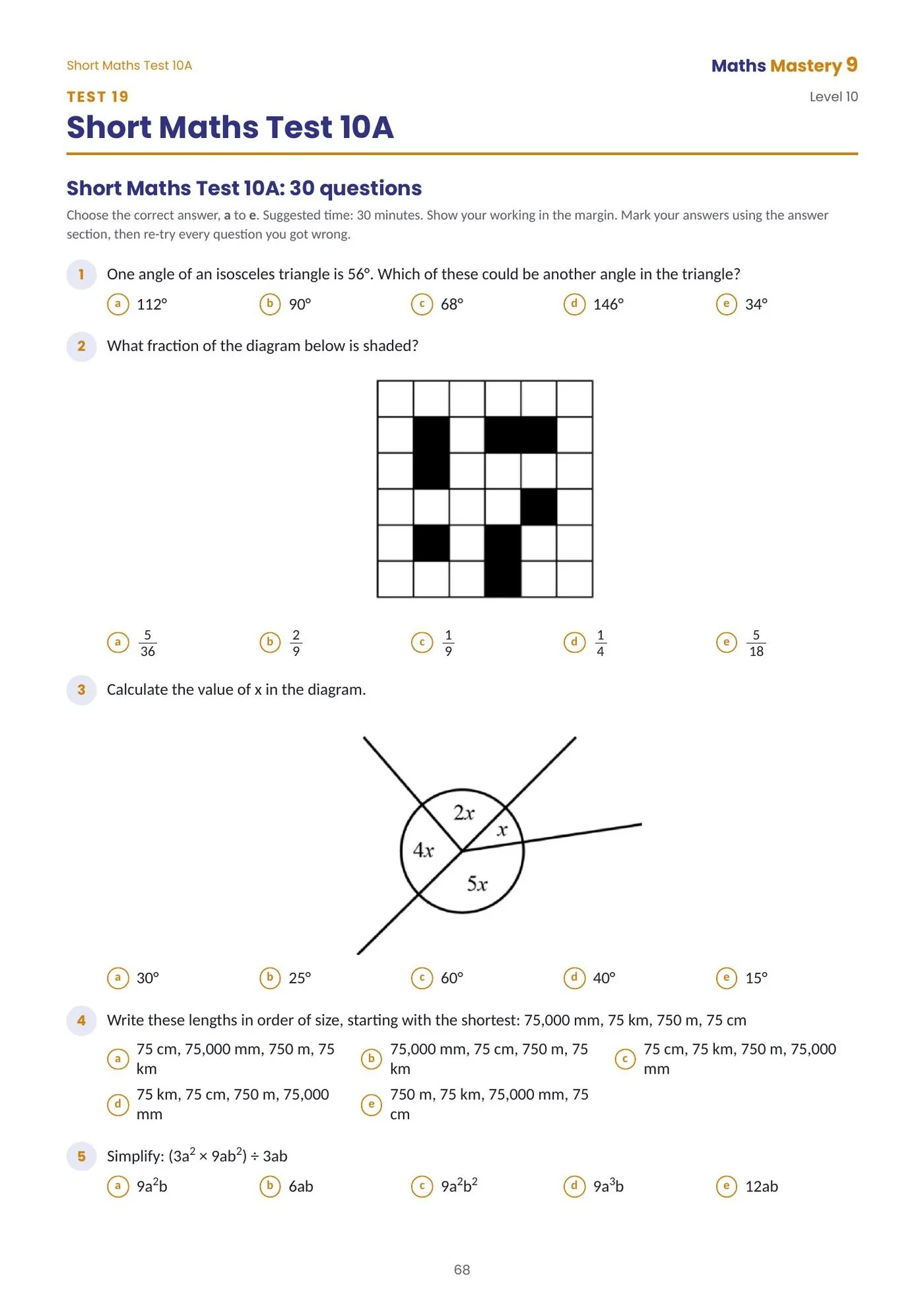
Level 10 is the real exam: an isosceles trap, a shaded grid, angles at a point in algebra, and 75 km against 75,000 mm.
Question 1 asks which angle could be another angle of an isosceles triangle with one angle of 56°, and two of the five answers look right for different reasons. Question 3 is 2x + x + 4x + 5x = 360°. Question 4 orders four lengths in four different units. Question 5 simplifies (3a² × 9ab²) ÷ 3ab. None of it is beyond a well-taught Year 5 child; all of it is lost at speed by a child who has never practised the mix.
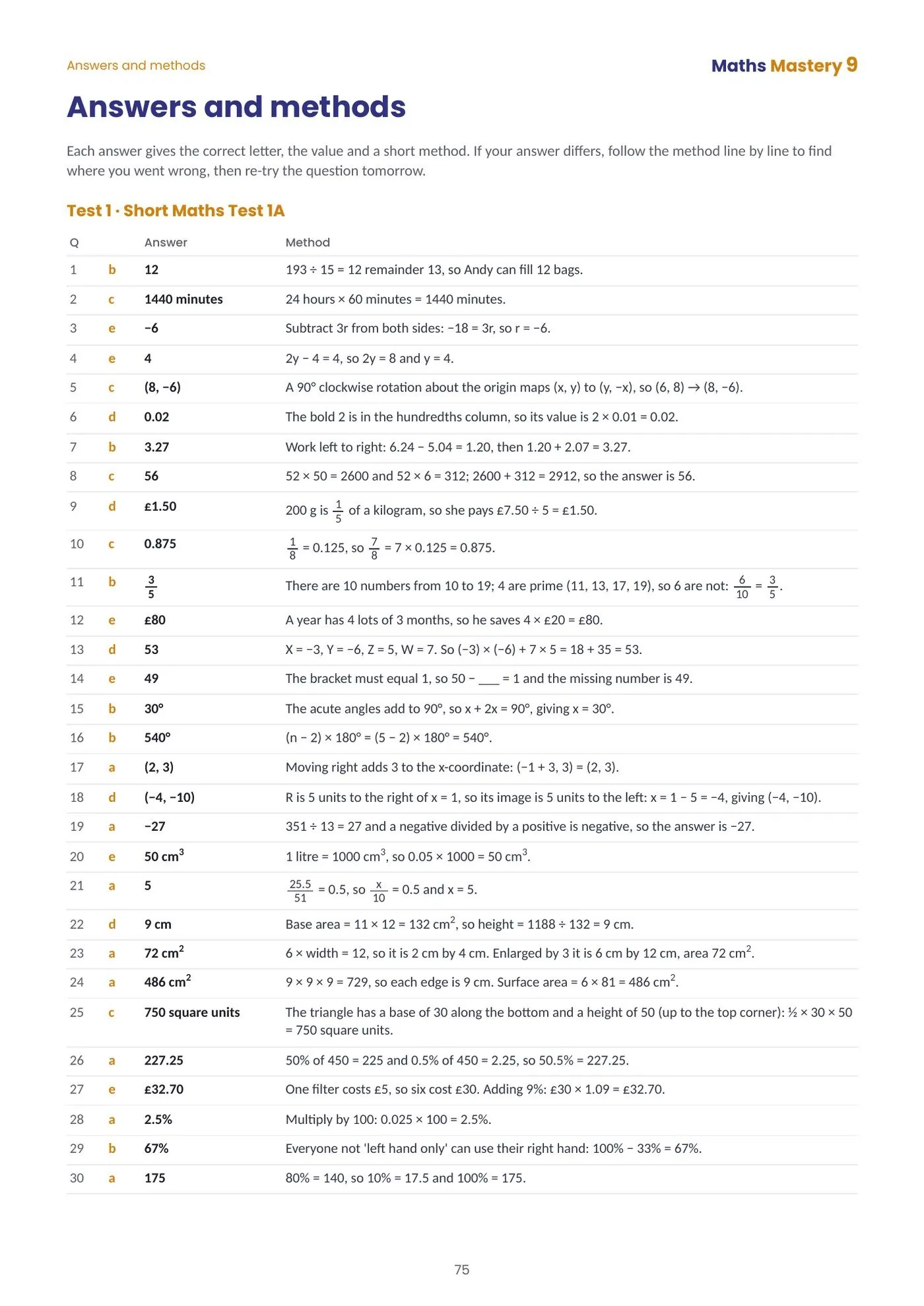
Every answer, every method, fully worked.
Question 5: "A 90° clockwise rotation about the origin maps (x, y) to (y, −x)." Question 11 lists the primes. Question 30: "80% = 140, so 10% = 17.5 and 100% = 175." Thirty short methods per test, each one the fastest correct route, so that the re-try the next day is done at exam speed rather than by a longer method that happens to work.
All 20 tests in the book follow the pattern shown here.
Other Year 5 books in Maths Mastery

Statistics & Data Handling
Reading charts, tables and averages quickly and without errors.

Algebra
Letters, sequences and equations introduced the way the 11+ sets them, not the way textbooks do.

Maths Rules & Quick Tests
Every rule from Books 1–6 on one page each, with a quick test to prove it is still there.

Long Maths
Multi-step questions with marks for method, laddered to scholarship standard.