 Click to enlarge
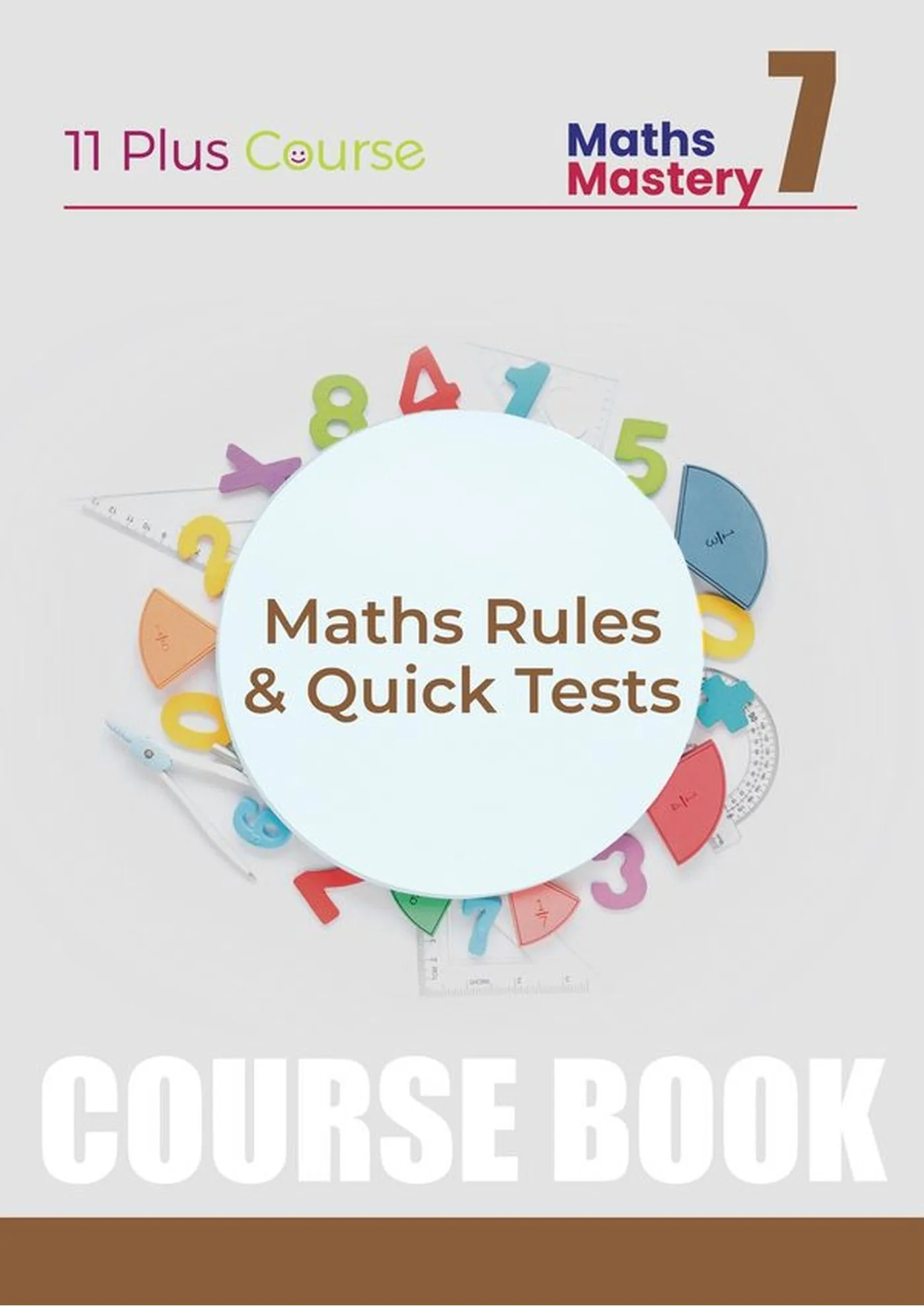
Maths Rules & Quick Tests
Every rule from Books 1–6 on one page each, with a quick test to prove it is still there.
- 27 tests covering everything in Books 1–6
- A one-page rules summary before every test
- Each test runs Foundation, then 11+ Standard, then stretch
- Every answer with its method fully worked
Want the whole series? The full Maths series is £247, under £21 a book.
How this book is used in our course
One test a week, alongside the Year 5 books. Read the rules page first, sit the 25 questions, then mark and correct. A test under 90% points straight back to the Book 1–6 topic that needs another pass.
Where it sits in the series
- Previous book in the series: Book 6, Algebra
- Next book in the series: Book 8, Mental Maths Foundations
What's inside Maths Mastery 7
Five real pages from the book, so you can see exactly what your child will work from. All 9 sample pages are in the viewer.
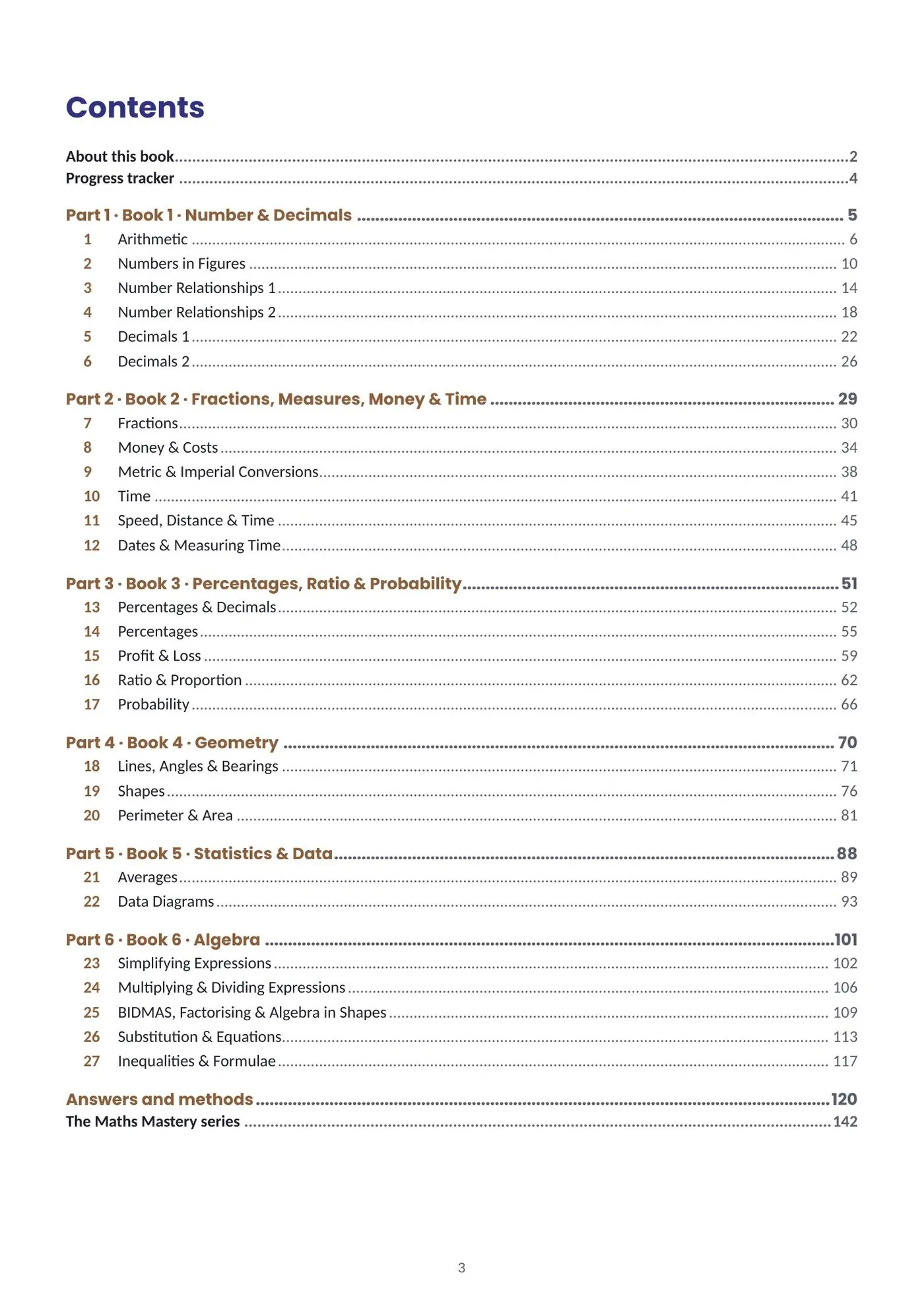
Twenty-seven tests that cover Books 1 to 6, so nothing learnt earlier is allowed to fade.
The contents page is a map of Books 1 to 6: six parts, one per book, from arithmetic and decimals through fractions, money and time, percentages and ratio, geometry, data, and algebra. Each test is one page of rules, then 25 questions. It is the revision book a child uses in Year 5 to find out which topic has gone soft before the exam does.
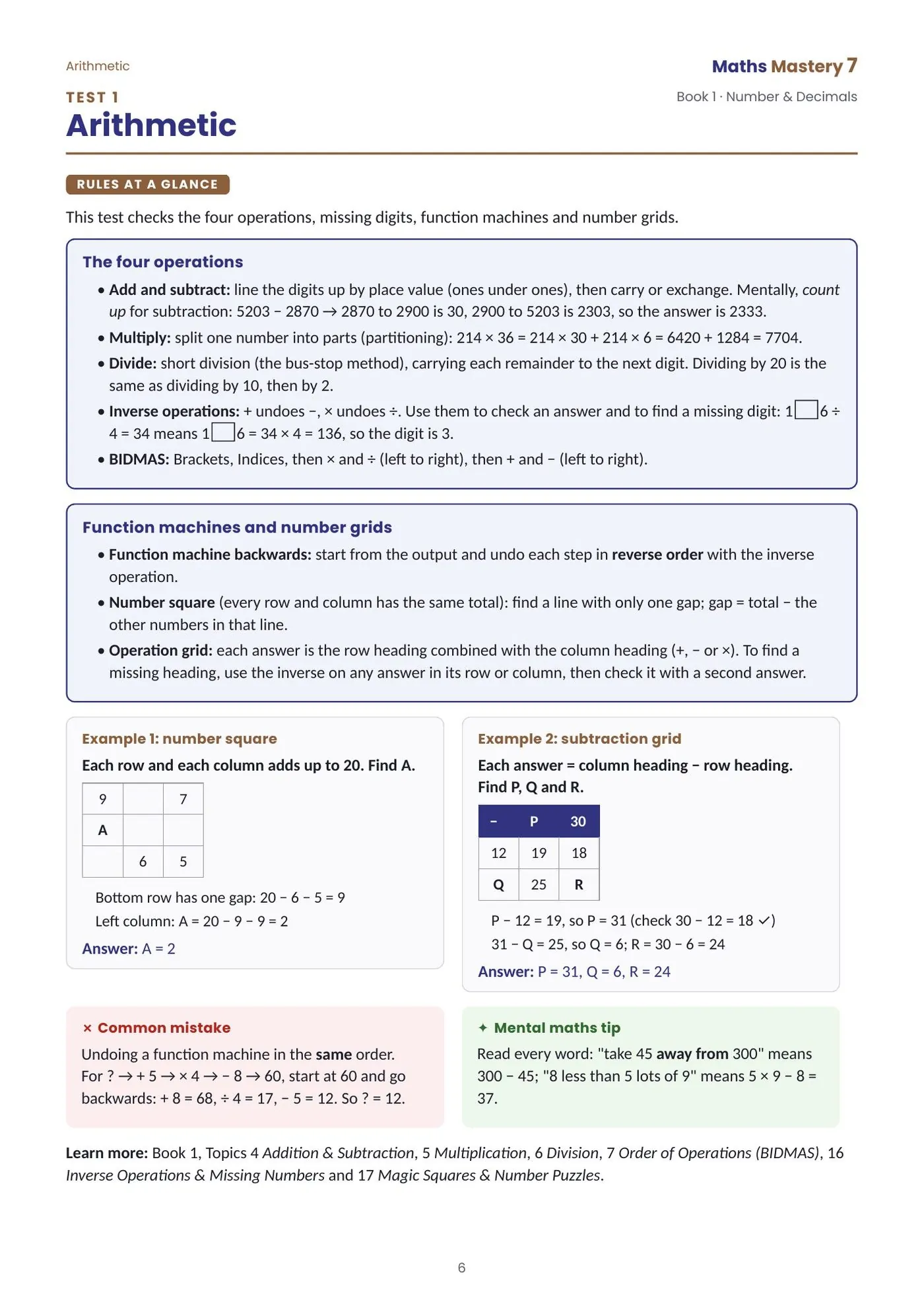
Every rule the test needs, on one page, before the test.
The four operations, inverse operations for missing digits, BIDMAS, function machines and number grids, each as a one-line rule with a worked number. Two worked examples, then a Common mistake box (undoing a function machine in the same order instead of reverse) and a Mental maths tip. The Learn more line points back to the exact Book 1 topics, so a weak test sends the child to the right page.
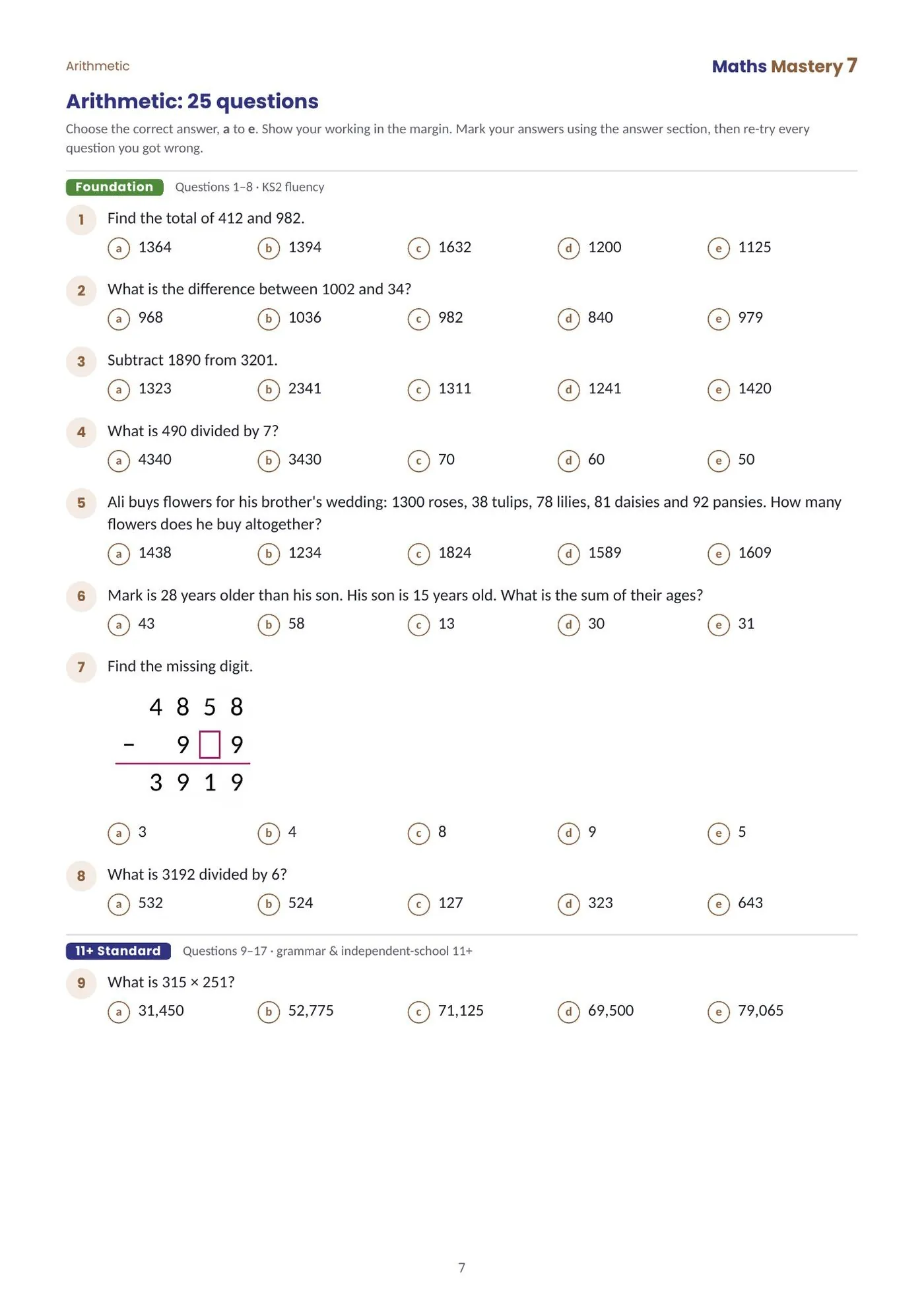
Foundation first, then 11+ Standard, then the stretch.
Questions 1 to 8 are KS2 fluency, labelled Foundation. Questions 9 to 17 are labelled 11+ Standard, grammar and independent school level, and start with 315 × 251. The labels are there so a parent can see at a glance where the marks stopped: a child who drops Foundation questions has a fluency problem, a child who drops only the top band has a reasoning one.
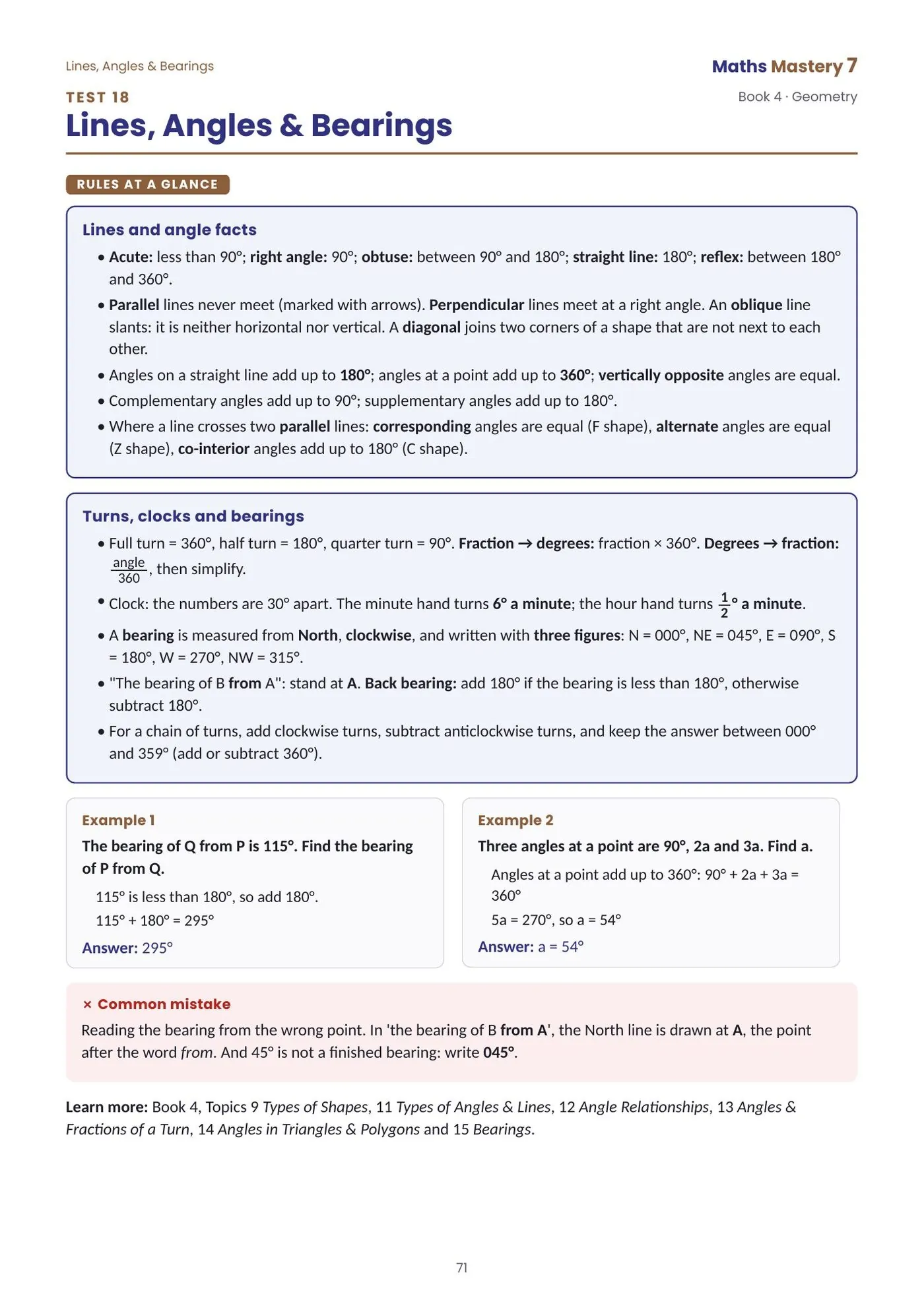
Angles and bearings: the facts, the clock, and the mistake that loses the mark.
Angle names, angles on a line and at a point, F, Z and C angles on parallel lines, then turns, clocks and bearings, including the back-bearing rule and the clock hands moving 6° and half a degree a minute. The Common mistake box names it: reading the bearing from the wrong point, and writing 45° when the answer is 045°.
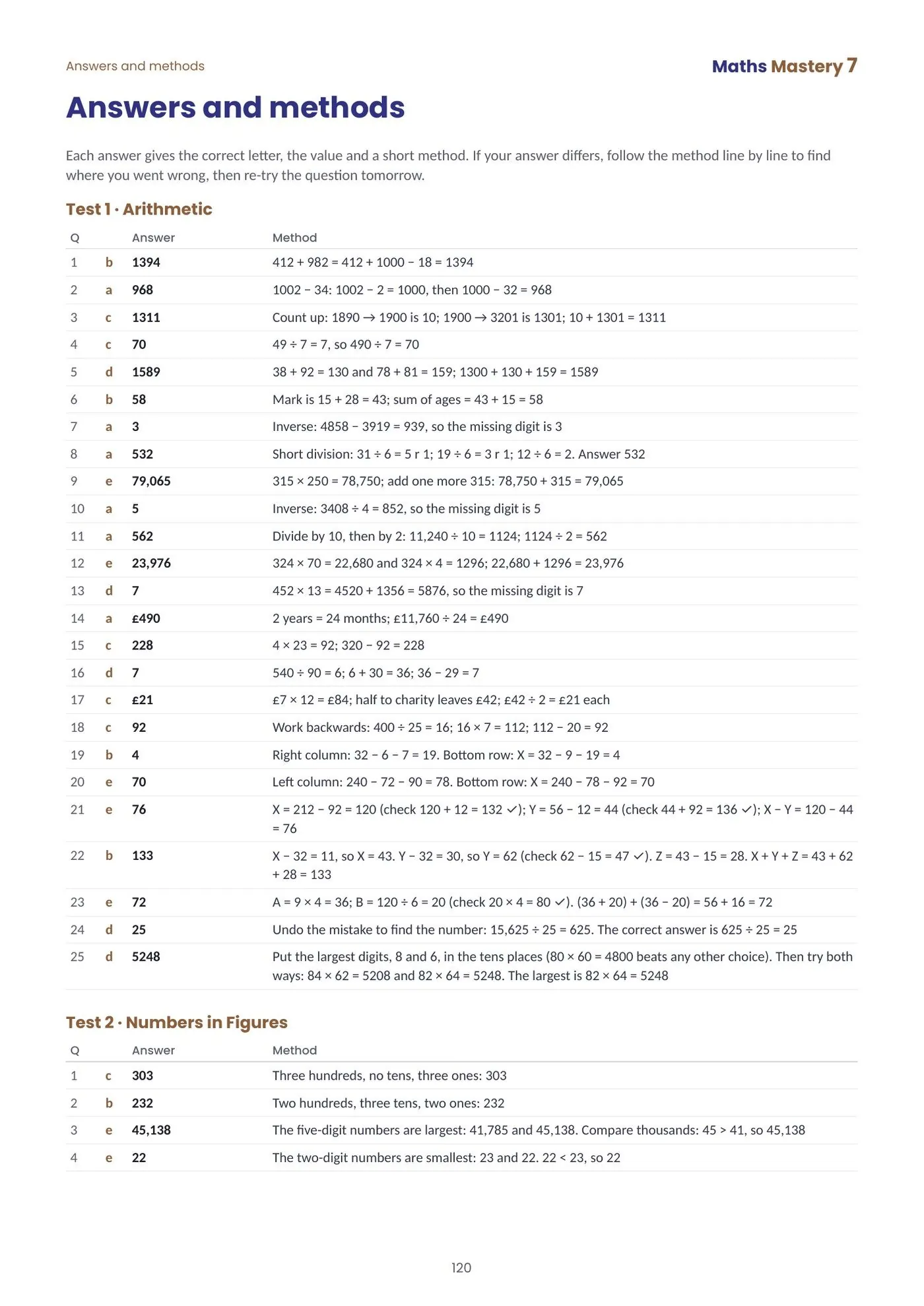
Every answer, every method, fully worked.
Question 24: "Undo the mistake to find the number: 15,625 ÷ 25 = 625. The correct answer is 625 ÷ 25 = 25." Question 25 explains why the largest digits go in the tens places, then tries both arrangements. These are the mental shortcuts a tutor teaches, printed beside every answer, so the re-try the next day is done with the right method.
All 27 tests in the book follow the pattern shown here.
Other Year 5 books in Maths Mastery

Statistics & Data Handling
Reading charts, tables and averages quickly and without errors.

Algebra
Letters, sequences and equations introduced the way the 11+ sets them, not the way textbooks do.

Short Maths
One-mark questions under the clock, where exams are won or lost on care.

Long Maths
Multi-step questions with marks for method, laddered to scholarship standard.