 Click to enlarge
Number Relationships & Decimals
Place value, number bonds, factors, multiples and decimals: the ground every later topic stands on.
- A rules page before every topic, written so a parent can teach from it
- 25 multiple-choice questions per topic, graded from accessible to scholarship level
- Full answer key
- Covers the whole 11+ syllabus across Books 1–6, then applies it in Books 7–12
Want the whole series? The full Maths series is £247, under £21 a book.
How this book is used in our course
Each topic opens with a rules page. A parent reads it with the child, then the child attempts the 25 questions unaided. Mark them, log the score, and work through every wrong answer with the key. Anything under 90% is repeated after a fortnight. The topic is only finished when the cold repeat clears 90%.
Where it sits in the series
- This is the first book in the series.
- Next book in the series: Book 2, Fractions, Measures, Money & Time
What's inside Maths Mastery 1
Five real pages from the book, so you can see exactly what your child will work from. All 9 sample pages are in the viewer.
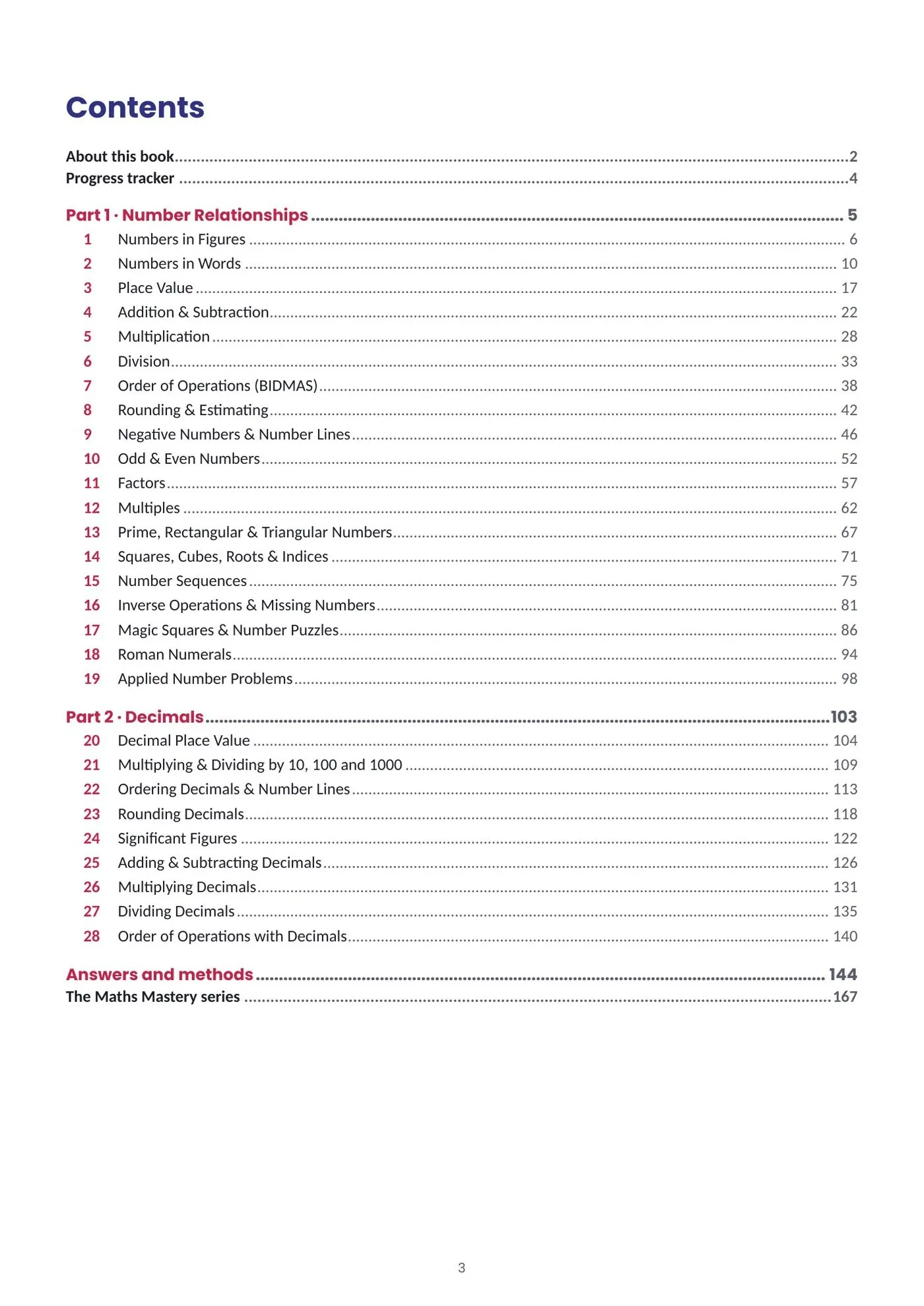
Twenty-eight topics in two parts, one method throughout.
Part 1 takes number relationships from place value and the four operations through BIDMAS, factors, primes, sequences and Roman numerals. Part 2 does decimals properly, from place value to the four operations. Every topic gets the same three pages: learn, worked examples, 25 questions.
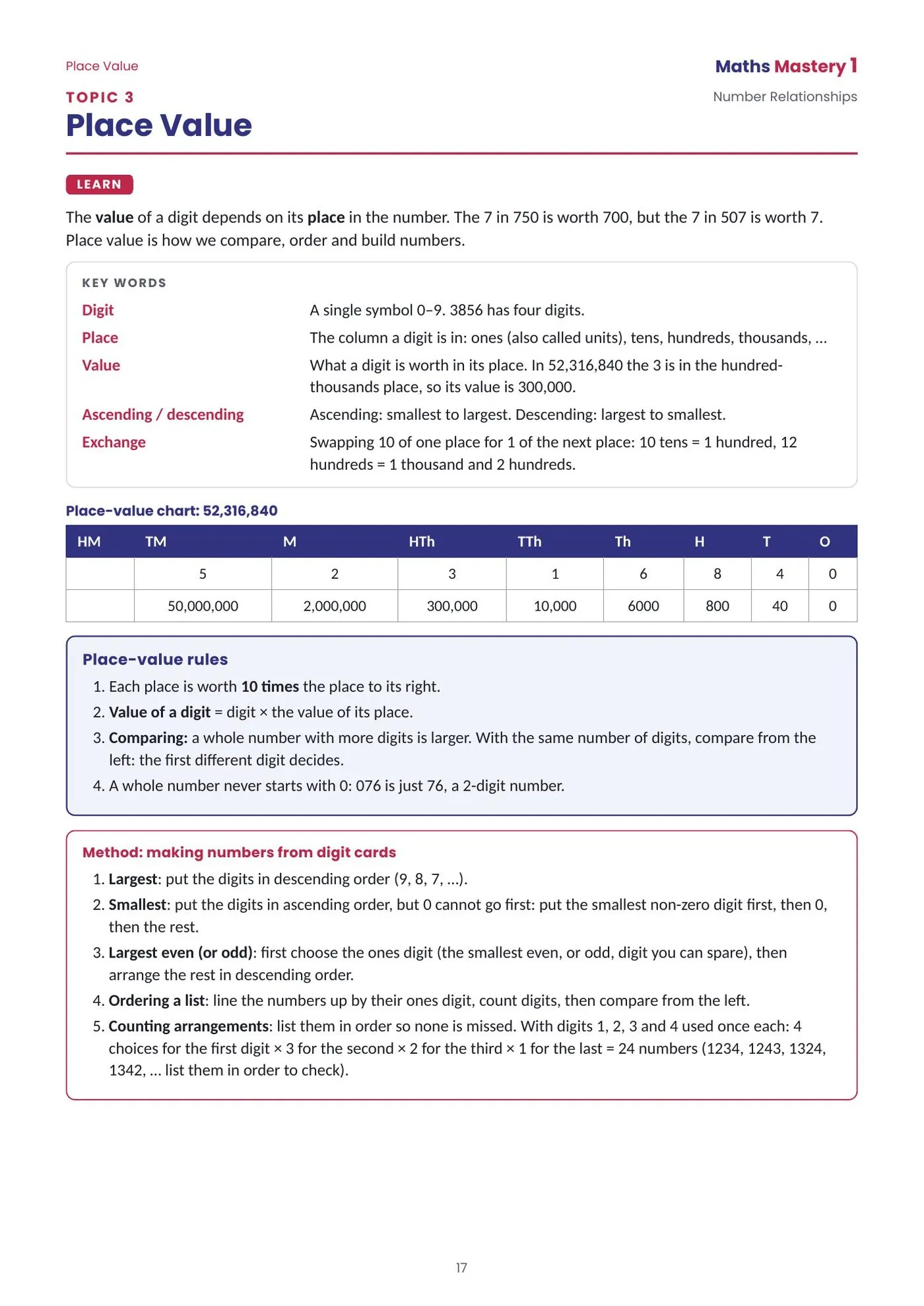
Every topic opens with the rule, in plain English.
Key words are defined before they are used, a place-value chart runs to 52,316,840, and four rules settle every comparison question. Underneath is the method for the digit-card questions grammar schools love: largest, smallest, largest even. A parent can read this page once and teach it.
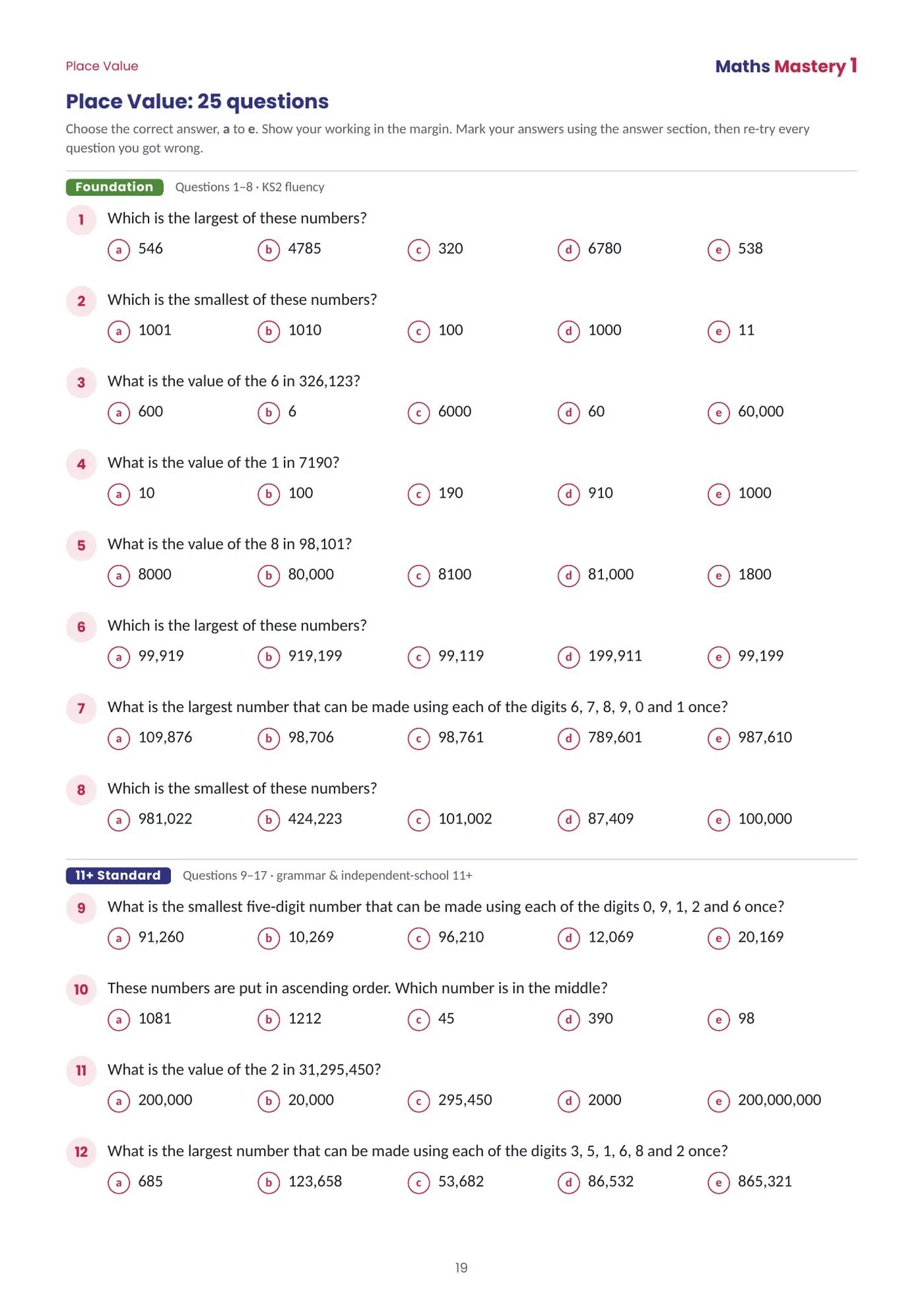
Twenty-five questions, laddered from Foundation to 11+ Standard.
Questions 1 to 8 are KS2 fluency, so every child starts with success; 9 to 17 are marked 11+ Standard, and the rest climb further. The instruction at the top is the whole method in one line: show your working, mark your answers, re-try every one you got wrong. Multiple choice a to e, exactly as the exam sets it.
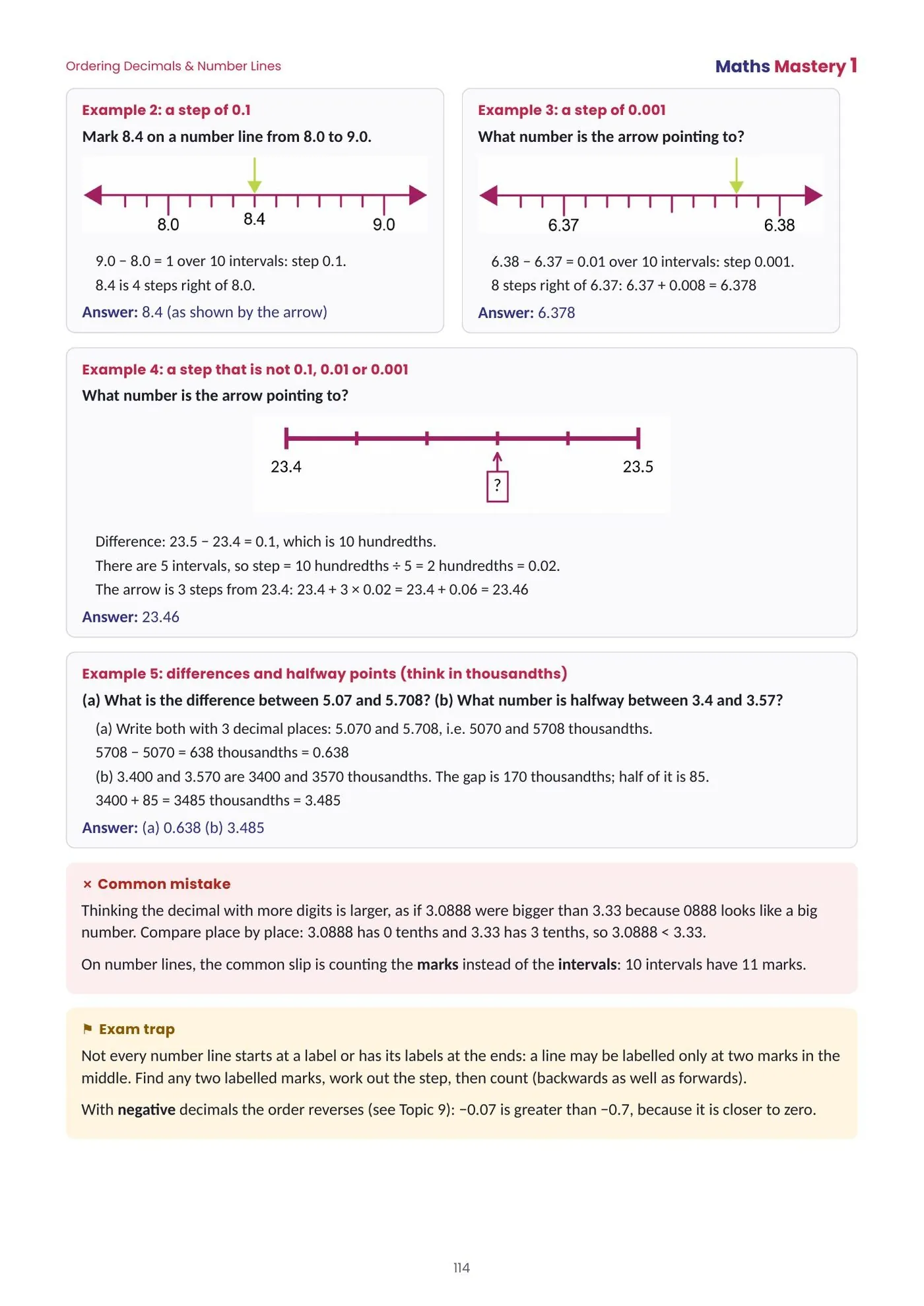
The mistake named, and the trap the examiner sets.
Every topic ends with two boxes. Common mistake: thinking 3.0888 is bigger than 3.33, and counting eleven marks as eleven intervals. Exam trap: number lines whose labels are not at the ends, and negative decimals, where the order reverses. This is the page that stops a child losing marks they know how to get.
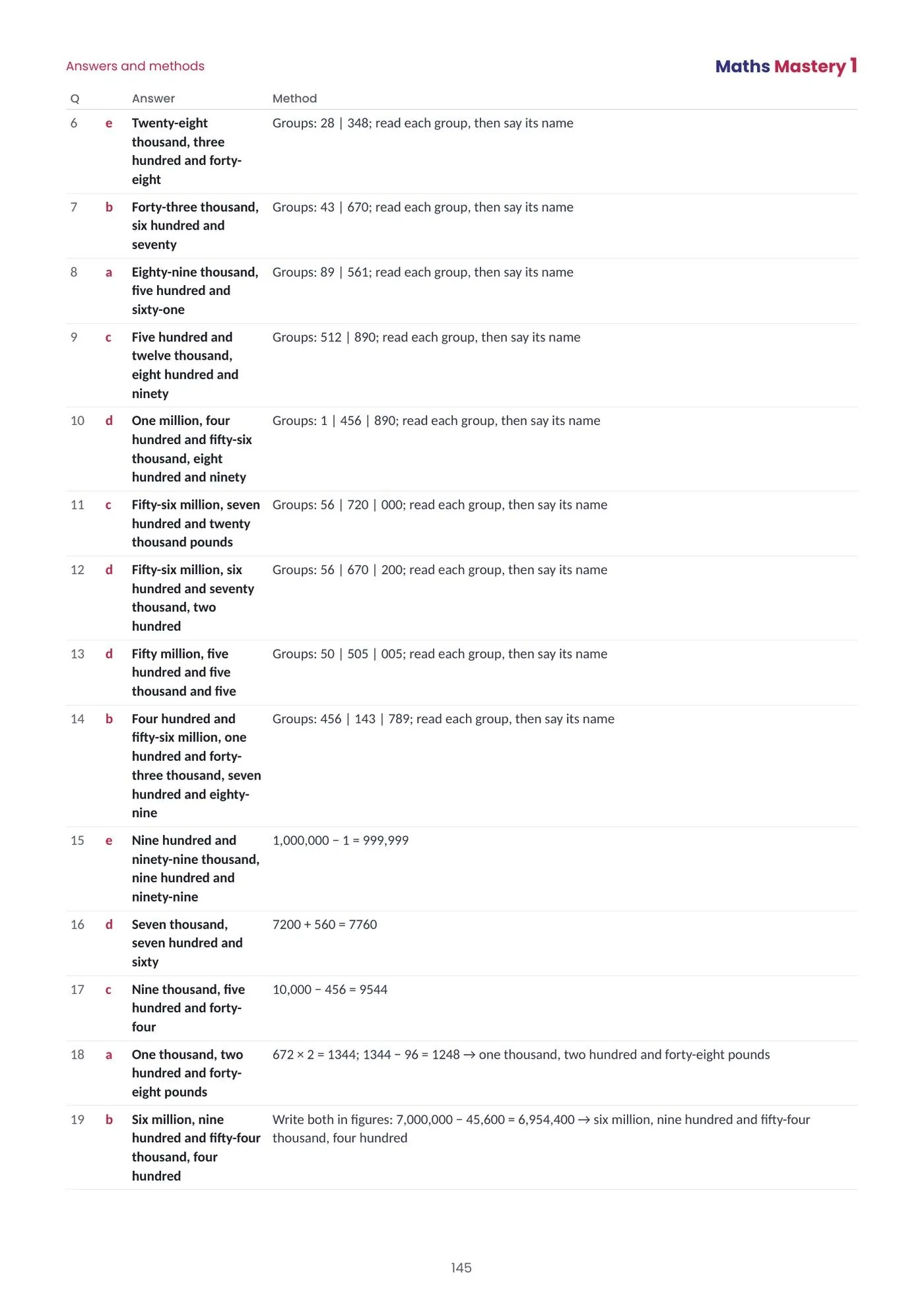
Every answer, every method, fully worked.
Not a letter in a grid: the question, the answer, and the method that gets there. "672 × 2 = 1344; 1344 − 96 = 1248." A parent who has not done this maths since school can explain any question, and a child marking their own work can see exactly which step broke.
All 28 topics in the book follow the pattern shown here.
Other Year 4 books in Maths Mastery

Fractions, Measures, Money & Time
The four topics that account for most lost marks in Year 4 maths, taught as one connected system.

Percentages, Ratios, Proportions & Probability
Proportional reasoning, the single skill that separates top-set maths from the rest.

Geometry: Shape, Space & Angles
Perimeter, area, angles, coordinates and nets, with the diagrams children actually meet in the exam.

Mental Maths Foundations
The Year 4 mental maths book. Speed and accuracy without a pen.