 Click to enlarge
English Rules 1
Grammar and punctuation rules taught one at a time, with examples a child can copy.
- 25 rules in the book
- Each rule taught one at a time, with examples a child can copy
- Full answer key, independently re-checked question by question
Want the whole series? The full English series is £497, under £19 a book.
How this book is used in our course
English books are worked in short daily sessions rather than one long sitting. For vocabulary, the child covers the meaning, says it aloud, then checks; words that are missed go on a card for the week. For comprehension and cloze, the child attempts the passage under a loose time, then marks against the key and rewrites any answer that lost marks.
Where it sits in the series
- Previous book in the series: Book 2, Vocabulary 1 Testbook
- Next book in the series: Book 4, English Rules 1 Testbook
What's inside English Mastery 3
Four real pages from the book, so you can see exactly what your child will work from. All 8 sample pages are in the viewer.
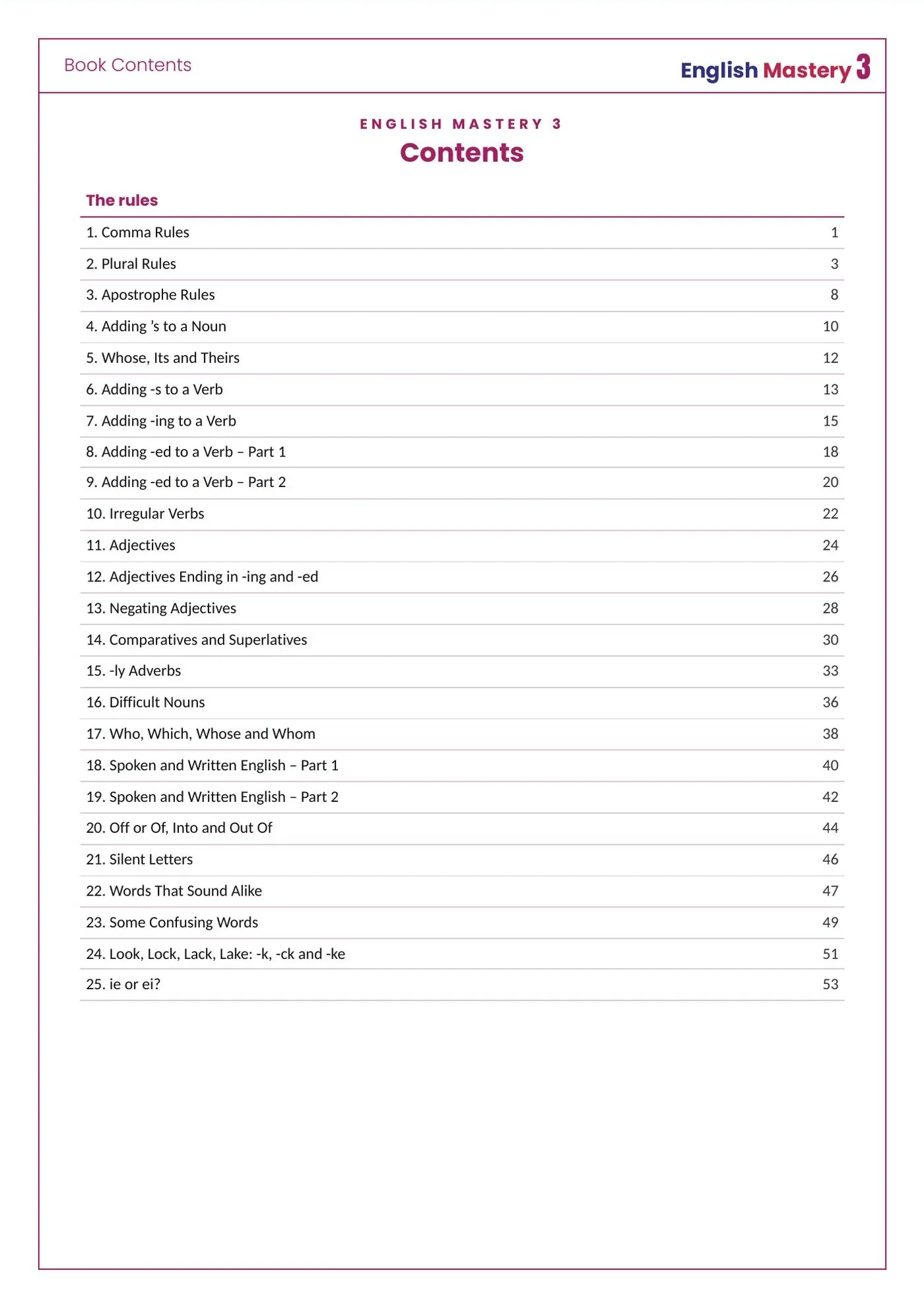
Twenty-five rules, one at a time, in the order a child needs them.
Commas, plurals, apostrophes, then the verb endings that trip up Year 4 writing: -s, -ing, -ed in two parts, and the irregular verbs. Adjectives, comparatives, -ly adverbs, who/which/whose/whom. Then the rules most schools never teach as rules: spoken versus written English, off or of, silent letters, words that sound alike, -k/-ck/-ke, ie or ei. Fifty-four pages, no padding.
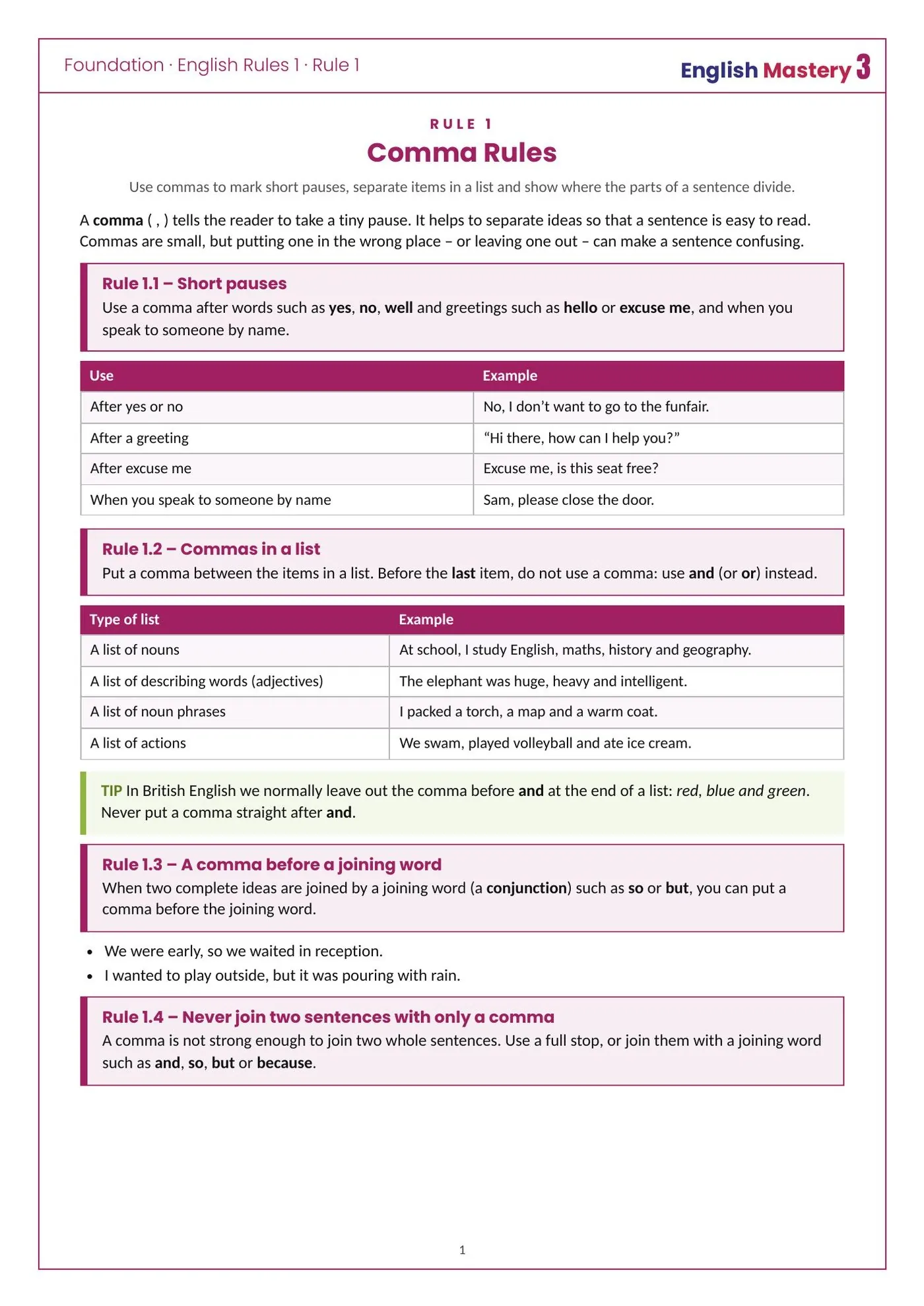
Every rule is numbered, boxed, and shown in a table of real sentences.
Rule 1.1, short pauses: after yes, no, a greeting, or a name. Rule 1.2, commas in a list, with four kinds of list and the British convention of no comma before and. Rule 1.3, a comma before a joining word. Rule 1.4, the one that marks down more 11+ creative writing than any other: never join two sentences with only a comma. A child can find the rule, read the example, and copy the pattern.
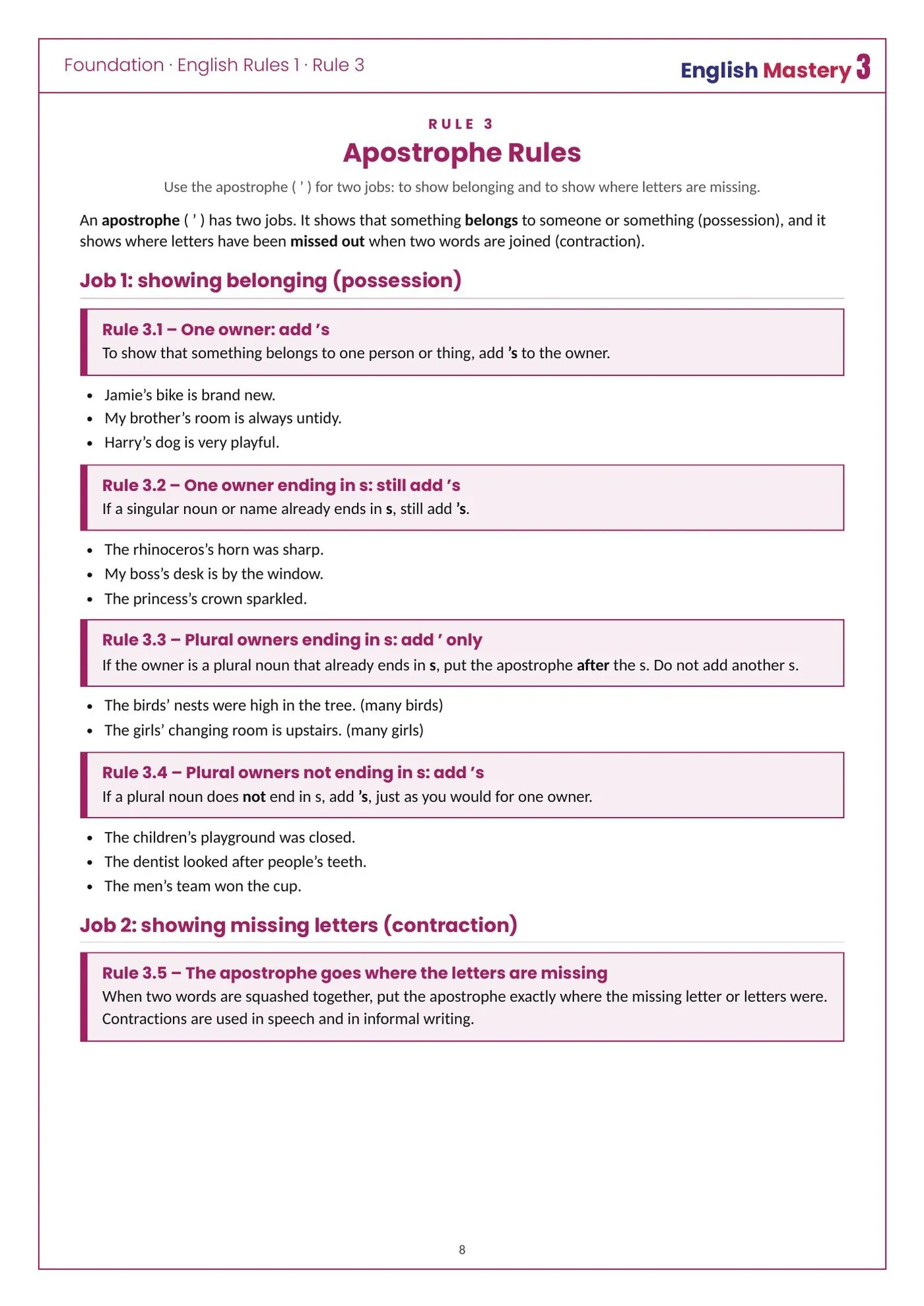
The apostrophe has two jobs. Most children have only been taught one of them, badly.
Job 1, belonging: one owner adds ’s, one owner ending in s still adds ’s (the rhinoceros’s horn), plural owners ending in s add the apostrophe only (the birds’ nests), plural owners not ending in s add ’s (the children’s playground). Job 2, missing letters: the apostrophe goes exactly where the letters were. Five sub-rules, each with three sentences, and the exam’s favourite punctuation question is covered.
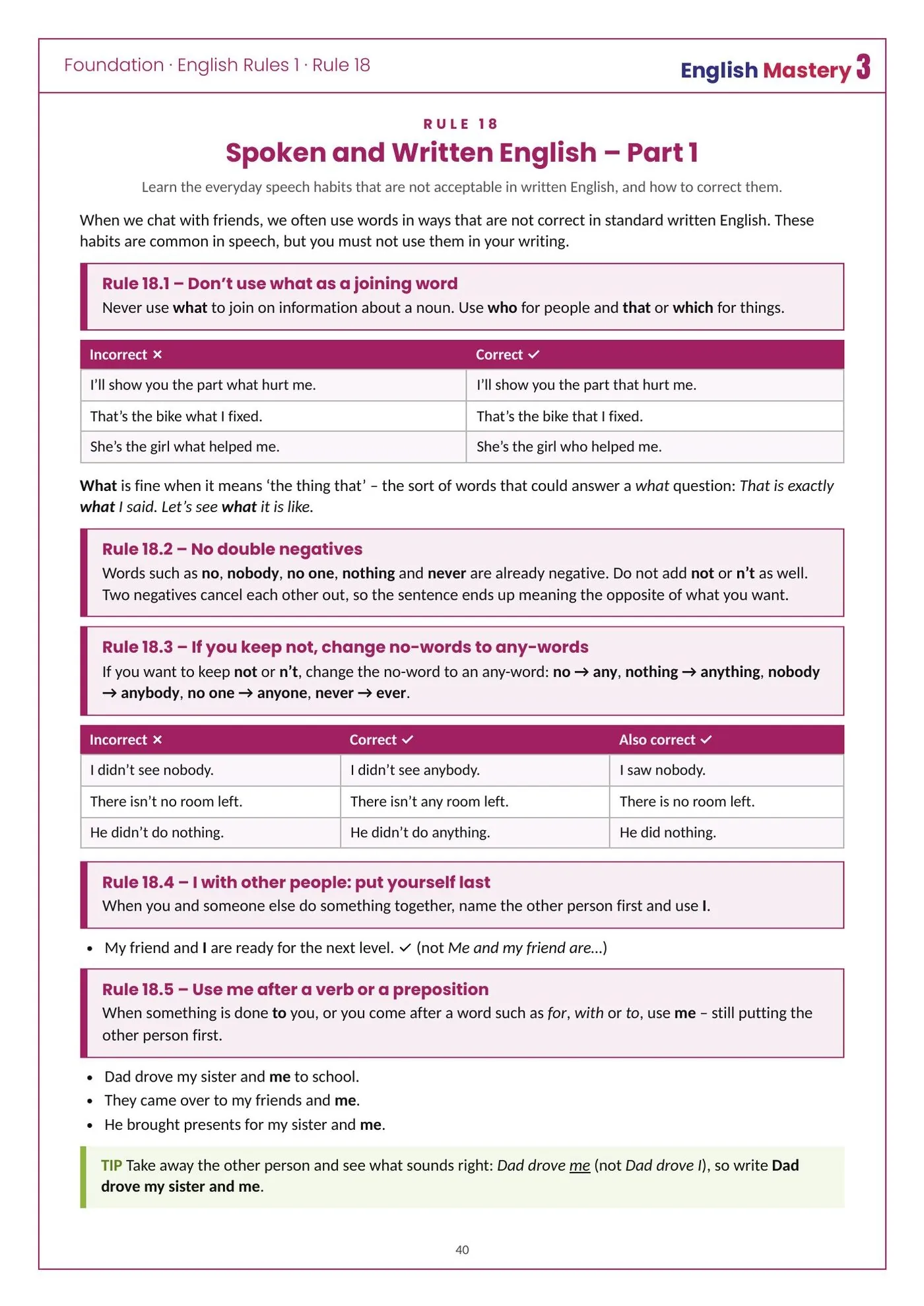
The habits a child picks up in the playground, and loses marks for in the exam.
"The bike what I fixed." "I didn’t see nobody." "Me and my friend are ready." Each one in a table: incorrect, correct, and where there is one, also correct. Rule 18.3 gives the fix for double negatives (change no-words to any-words), and the tip at the bottom gives the test for I or me: take the other person away and see what sounds right. This is the page that turns a chatty child into a child who writes standard English on the day.
All 25 rules in the book follow the pattern shown here.
Other Year 4 books in English Mastery

Vocabulary 1
The first word list: each word with a child-friendly meaning, synonyms, antonyms and a sentence.

Vocabulary 1 Testbook
Tests every word in Vocabulary 1 the way the exam does.

Vocabulary 2
992 words in 25 alphabetical sets, with meanings, synonyms, antonyms and sentences.

Vocabulary 2 Testbook
Tests every word in Vocabulary 2.