 Click to enlarge
The Technique Booklet
The complete Writing Formula in more than 380 pages: plan in five minutes, write four paragraphs, check your own work, then every other kind of task.
- The Writing Formula: four decisions when the title is read, four paragraphs with one job each
- The five-minute plan and the Formula Check
- Banks of colour words, vocabulary, sentence types, openers and devices
- Five settings and five characters built step by step
- Three full worked stories, plus picture prompts, descriptions, persuasive writing and continuations
Want the whole series? The full Creative Writing series is £129, under £17 a book.
How this book is used in our course
The Technique Booklet is the course. Work through one section at a time: read it with your child, try its examples, then write. Every new piece is planned in five minutes, written in four paragraphs, checked with the Formula Check, then improved and written again. The other books in the series plug into it.
Where it sits in the series
- This is the first book in the series.
- Next book in the series: Book 2, Your Writing Toolkit
What's inside Creative Writing Mastery 1
Five real pages from the book, so you can see exactly what your child will work from. All 11 sample pages are in the viewer.
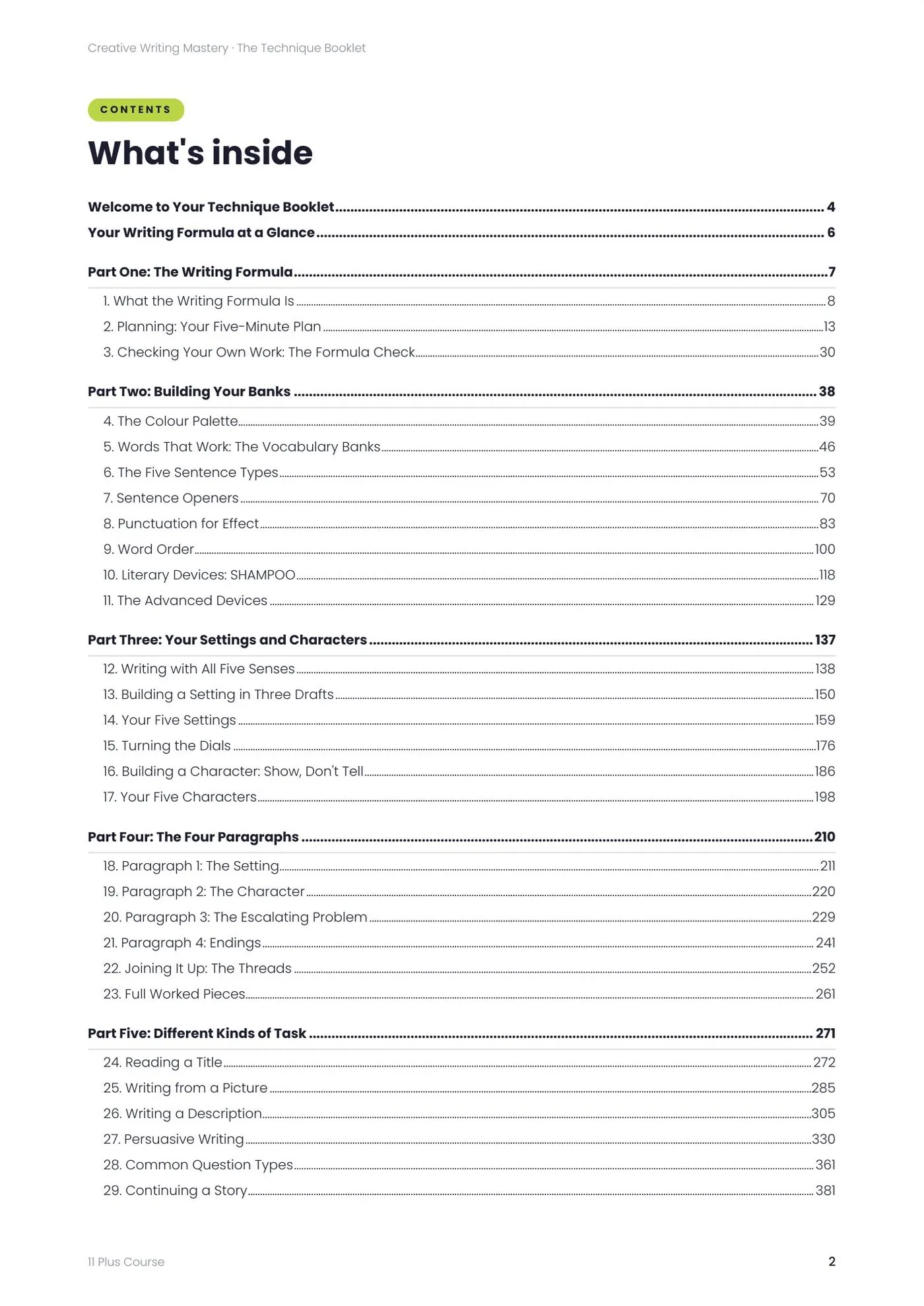
Five parts, more than 380 pages: the whole of 11+ creative writing, taught as one method.
Part One is the Writing Formula: what it is, the five-minute plan and the Formula Check. Part Two builds the banks: colour words, vocabulary, five sentence types, sentence openers, punctuation for effect, word order and the devices. Part Three builds five settings and five characters. Part Four writes the four paragraphs and joins them up. Part Five takes the formula into every other kind of task: picture prompts, descriptions, persuasive writing and continuing a story.
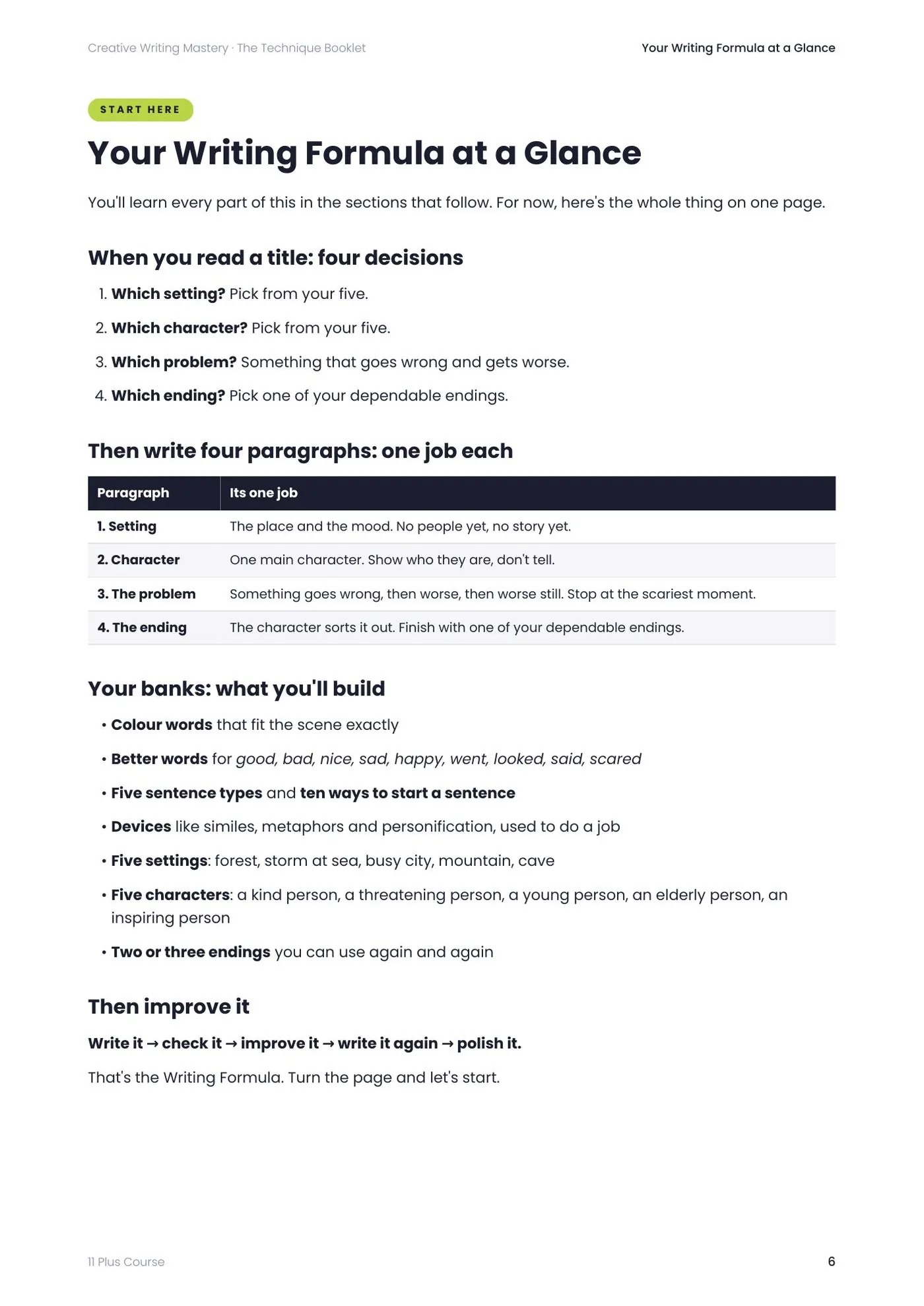
Four decisions when the title is read. Four paragraphs, each with one job.
Which setting, which character, which problem, which ending: each one picked from a portfolio the child has already built. Then paragraph one is the place and the mood, paragraph two is one character shown rather than told, paragraph three is a problem that goes wrong, then worse, then worse still, and paragraph four sorts it out with a dependable ending. Write it, check it, improve it, write it again, polish it. That is the formula, on one page.
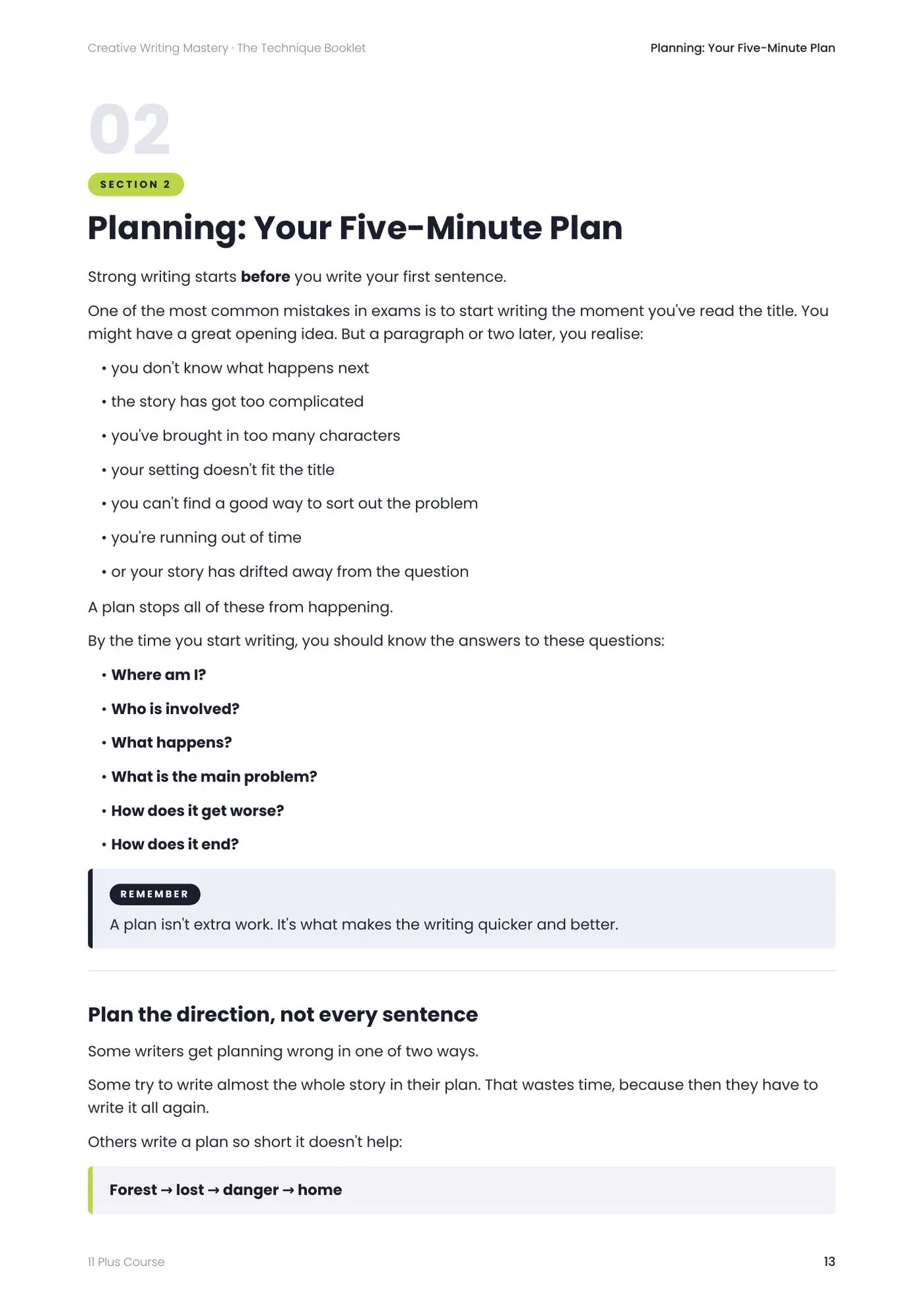
The mistake that ruins more stories than any other: writing the moment the title is read.
Two paragraphs in, the child realises they do not know what happens next, the story has too many characters, the setting does not fit the title, or the clock has run out. The five-minute plan stops every one of those before the first sentence. It is the habit that separates a story that finishes well from one that drifts away from the question.
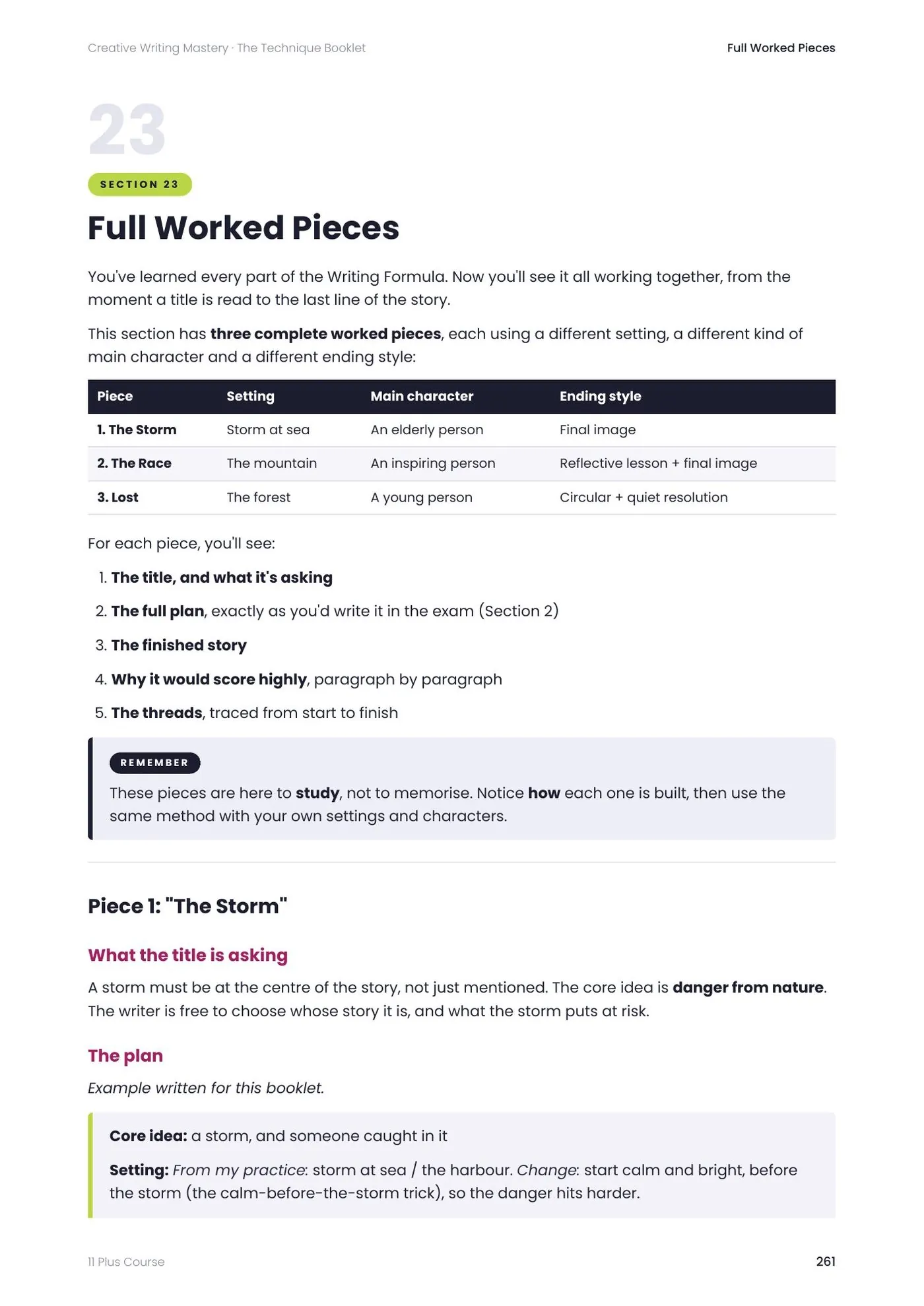
Three complete stories, from reading the title to the last line, with the plan shown.
"The Storm", "The Race" and "Lost": three settings, three kinds of main character, three ending styles. For each, the title and what it is really asking, the plan exactly as it would be written in the exam, the finished story, why it would score highly paragraph by paragraph, and the threads traced from start to finish. Here to study, not to memorise.
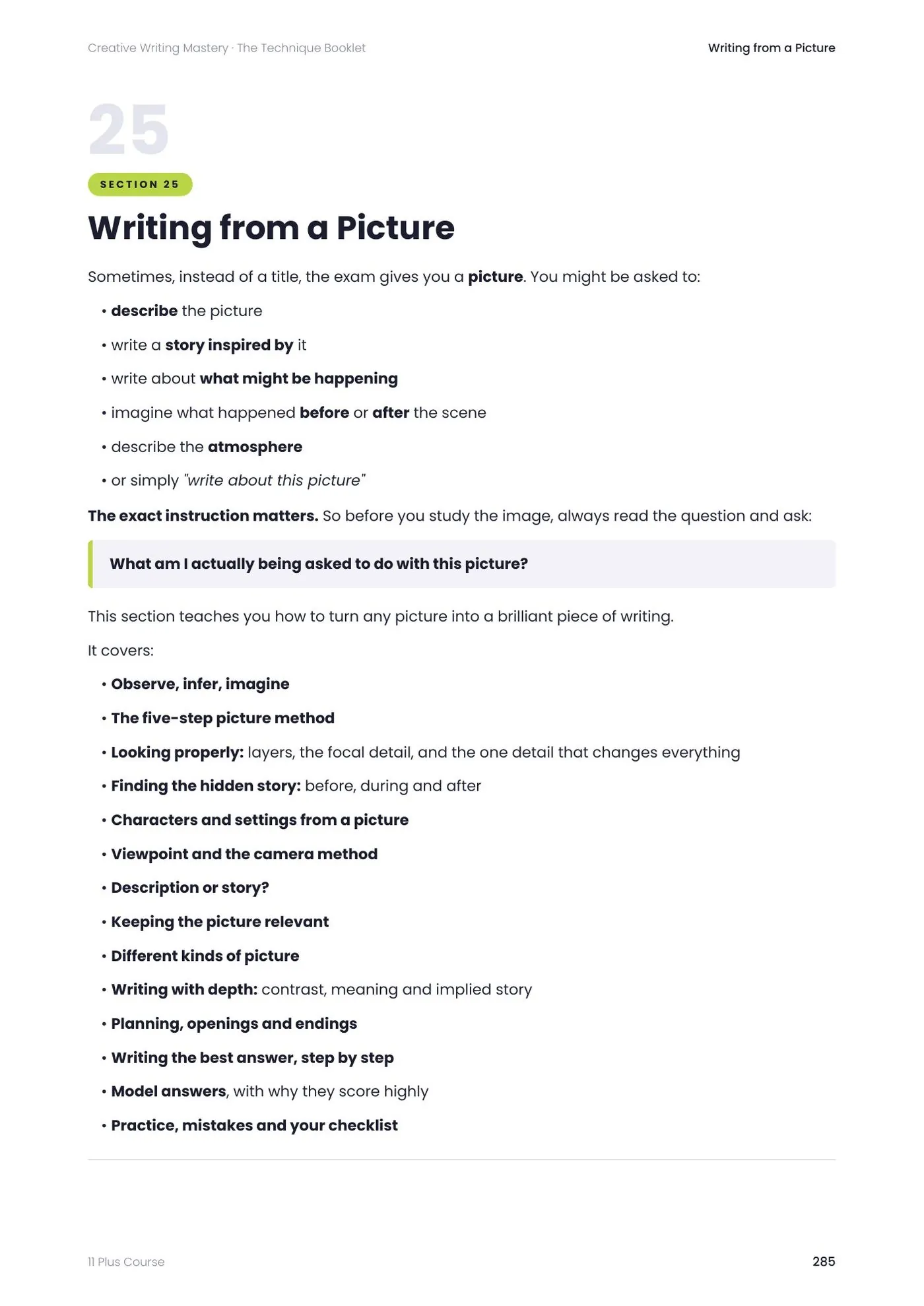
When the exam gives a picture instead of a title, the method still works.
Read the instruction first: describe it, write a story inspired by it, or imagine what happened before or after. Then observe, infer, imagine; find the one detail that changes everything; choose the viewpoint; decide description or story. Model answers show why they score highly. Descriptions, persuasive writing and story continuations follow in their own sections.
Every section in the book follows the pattern shown here.
Other Year 4 & 5 books in Creative Writing Mastery

Your Writing Toolkit
Every checklist, every mistake to avoid, the glossary and seven templates, open beside every piece of writing.

Settings & Characters
The scholarship groundwork: five annotated model settings, two bonus settings and five model characters, each with the blueprint behind it.

Settings & Characters: Model Descriptions
Ten short model paragraphs to read, learn and adapt: five settings and five characters.

6-Minute Drills
Every setting and character written against the clock, marked out of 10, then redrafted to scholarship standard.